Thursday, August 1, 2013

Germplasm

I love the word germplasm! It sounds all organic and squelchy, like wet bits inside a plant cell. \But it's not an onomatopoeic word (if that is a word in itself). Wikipedia defines germplasm as meaning a collection of genetic resources for an organism. So for example, for plants, germplasm can be a stored seed collection or for trees, a nursery or botanical collection (like my favourite Breadfruit Institute). In a world where humans are bent on taking over and turning every bit of usable land into cultivation, roads or cities, conserving germplasm resources becomes very critical.

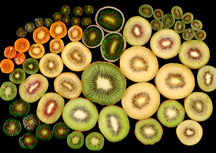
Kiwifruit germplasm - Plant & Food Research New Zealand
In an earlier post, I talked about the ancestry of wheat - quite a remarkable breeding effort by early human civilisations in weaving something quite harvestable and edible out of a collection of a couple of different grass species, in a series of crosses. How these early plant breeders, 10,000 years ago, mucked around with the less than "useful" weeds like Goat's grass (Aegilops tauschii ) and einkorn wheat (Triticum urartu) to form such a staple crop as wheat, we can only ponder now. Various groups are now using these ancestral parents to try to make new crosses to improve on modern wheats, such as the National Institute of Agricultural Botany in the UK. But they could not do so if it weren't for the efforts of dedicated people over the past 80 or so years, collecting germplasm from wild populations and saving them in seed banks around the world.

Some of the most famous germplasm centres in the world are the Svalbard Global Seed Vault in Norway, CIMMYT in Mexico, and ICRISAT in Syria. New Zealand has it's very own centre in the Margot Forde Germplasm Centre - a collection or pastoral and arable species which form the basis of agricultural production in New Zealand. The collection superviser, Zane Webber, heads overseas twice a year on collection trips into places like Sicily and Russia, hunting out new sources of ryegrasses and clover which may be of benefit to New Zealand plant breeders.

I was recently interviewed by Richard Loe on Radio Live about the changes the Ministry for Primary Industries has madeto enable New Zealand breeders better access to seed within this collection.
htt\/www.radiolivesport.co.nz/Audio/Katheryn-Hurr---MPI/tabid/454/articleID/14923/Default.aspx and here http://www.radionz.co.nz/news/rural/214563/rules-change-for-imported-seeds


It's not impossible for non-scientists to be involved in germplasm conservation. Kay Baxter of the Koanga Institure in Northland is a great example of a woman with a mission to save New Zealands heritage vegetable and fruit tree varieties. And Mark Christensen of the Central Tree Crops Research Trust (part of the Tree Crops Association) is also coordinating some large projects around apples, tomatoes and beans.


Plenty of inspiration there.

Monday, August 6, 2012

It's bean a while...

…since I last wrote my blog. Suffice to say I have moved house twice, and now a year later, new gardens are dug, the compost bins are all lined up in a row like little daleks…and the botanical adventures continue. Today's blog is about beans.

The first time I encountered soybean plants growing, I had no idea what I was looking at. They were potted up in a greenhouse at the Donald Danforth Plant Science Centre in St Louis, Missouri. Soybeans  are so common in the US the plant scientist must have wondered what planet I'd grown up on, but in all fairness they are not commonly grown in New Zealand. 

Soybeans ready for picking at the green-stage.
Five years later, I tried some Edamame beans cooked in the pod at a Japanese restaurant in Parnell, Auckland. They were so delicious that when I spotted some seeds in the Kings Seeds catalogue, I decided I'd have a go at growing them myself.  I put them in the greenhouse because I wasn't sure how they'd go in a cool-temperate climate, and they went very well indeed. The leaves were intensely desirable to caterpillars, however, with infestations of the dastardly creatures reducing the leaves to mere veins. No wonder commercial bean crops are either heavily sprayed with pesticides or genetically modified with a Bt toxin to stop these critters. In my small patch, squeezing caterpillars between my fingers worked well! I harvested a few beans at the fresh shell-stage, as shown in the picture above, which my work colleague assured me was the right stage to eat them green (as edamame). At this stage, they're often called butterbeans, and they are harvested just as the pods begin to lose their bright green colour. I was surprised by the volume of beans I got from a dozen plants. I tried cooking them in the pods, but the pods were hairy and tough. I’m not sure how that Japanese restaurant prepared them in this way.

They were quite delicious shelled green and cooked for five minutes or until tender. I froze a couple of small bags of them to use later in the year. Very nice added to stir fries or to dishes where you’d normally use peas or other beans, like broad beans. The most time consuming thing was shelling them - they are a lot more fiddly than peas, but then I did find a website which recommends steaming them in their pods for a few minutes, leaving them to cool, podding them and then re-cooking them.

If you  want to save the seeds, or store the beans to eat later, you need to leave the beans to mature further and dry in the pods. But then they need to be soaked and cooked a lot longer. 
 
They are very high in complete protein and provide lots of the essential amino acids and I’m quite happy to grow them again. I’m going to try growing them outside this year.


Buoyed by my beans experience, I’ve volunteered myself for a project being run by the Central Tree Crops Research Trust in Whanganui "Adopt an Ancient Bean”. The project aims to enlist New Zealander's to grow 29 ancient varieties of beans sourced from heirloom seed organisations across the USA. An American seed saving group have been growing the beans to meet the phytosanitary import requirements of New Zealand. The varieties which have been selected include some ancient and beautiful North American Indian varieties (Hopi), some traditional Mexican varieties, as well as some early American Settler varieties. I'll let you know if they pick me to grow a variety and update progress :)


Friday, August 12, 2011

Stretchy ice-cream

This year is the "Year of Chemistry" and in August we also have "Wellington on a Plate" - so to celebrate both, the Chemistry Department of Victoria University invited Kent Kirshenbaum from New York University to present a couple of lectures this week on Chemical Gastronomy. Kent has founded a group in the States called Experimental Cuisine, which aims to understand the chemical and physical process of cooking, and is on a mad-cap adventure to find alternatives to traditional ingredients.  For example, pavlova without egg whites?! The idea is that chefs can learn a thing or two from chemists, and likewise chemists could learn a thing or two from chefs. Good stuff.

Kitchen chemistry is hot news right now - Kent said it was listed number 5 in Time's Top 10 list for 2010, wedged in between global warming and stopping terrorism! Certainly we've been enjoying our cooking shows on TV the past few years, learning how to make mango caviar using sodium alginate (the ions form a bridging link, pulling the polymers together), and learning that by precisely cooking an egg at 62.5 degrees C (in a water bath which looks suspiciously like the one in my old molecular biology lab) the cooked yolks are supple enough to be rolled out like pastry. Hmmn, that gives me a few ideas... If you want to read some more on this subject, and try some experiments yourself, check out  Cooking for Geeks by Jeff Potter and Molecular Gastronomy by Herve This.


But what interested me the most in Kent's talk was the prospect of making my very own stretchy ice-cream from none-other-than one of my all-time favourite plants, Amorphophallus konjac! Traditional stretchy ice-cream, or Salep Dondurma as it's known in Istanbul, is made from milk sweetened and flavoured with mastic, an aromatic resin, and thickened with salep, the powdered bulbs of wild orchids. Not just any orchid, but orchids from the Anatolian mountains - Orchis mascula or Orchis militaris - which look a little like a Hyacinth in flower. The orchid bulb contains a mucilaginous carbohydrate called glucomannan which, when dissolved in milk, binds up and blocks the movement of water molecules, thickening the milk. "Salep" is an Arabic word for "fox testicle", presumably referring to the shape of the orchids bulb (I am unable to confirm the likeness due to the general shortage of Vulpes vulpes in New Zealand). Salep is becoming expensive and hard to source, as the orchids are becoming increasingly scarce in the wild. But good news! there are other botanical sources of glucomannans which can do the job.  Enter again my dear Amorphophallus...


I've had this plant for over twenty years now. It comes up every spring time, forms this luscious green canopy with a leopard-spotted trunk, always attracts lots of attention and comments, and then dies back at the start of the winter to it's underground corm. When the plant has stored up enough energy, it flowers - an enormous black/purple arum flower on a stalk, which stinks like a dead hedgehog... Mine has only flowered twice in twenty years - and it goes outside when it does! Each year the big corm creates lots of new little corms, so eventually I had a small forest in my pot, and I have given tens of them away over the years. Kew Gardens have a giant species - Amorphophallus titanum - standing about 3m tall with a trunk about 15-20cm in diameter. I will try and find my photo of it and post it here.

 
Amorphophallus in flower - phew
Amorphophallus titanum, at Kew Gardens in London.


Anyway, back to the stretchy ice-cream.... Amorphophallus konjac also has a high glucomannan content, and can apparently be used as an alternative for salep. Konjac flour looks to be readily available in Japan, and is used for all sorts of things. But I'm wondering, in the spirit of having a botanical picnic, if I can just dry a corm or two out and process the flour myself at home?


Should you wish to try it too, here is the recipe for Konjac Dondurma
2 grams mastic (optional)
8 grams konjac flour
1.6 L whole milk
410 grams sugar
The corms
2 Litres of liquid nitrogen (for cooling. You could probably cool the ice cream in the usual, less dramatic, way. Maybe an ice cream maker would work too?).

I'll let you know how mine turns out.


Friday, June 24, 2011

Wonderful breadfruit!

If you've never heard of breadfruit before you must definitely read up on this wonderful plant, it's story is fascinating! Artocarpus altilis is the scientific name. It grows as a medium to large tree, with fabulously large deltoid leathery leaves and large green ovoid fruit. The fruit are very dense in carbohydrates, vitamins and minerals - and can be cooked in many different ways, similar to potatoes. It was the food that fueled the Polynesian migrations across the Pacific - from west to east - with the canoe people taking fruit for food on the way, and little plants to start off new plantations in their newly-discovered islands. Closely related varieties which are seeded exist in New Guinea - and then from west to east, progressively, the varieties have fewer seeds until they are completely seedless in Samoa and Tahiti. Did seedlessness occur because the Polynesians selected for seedlessness, or was it a consequence of them propagating the plants from sprouts from the base of the tree (vegetative propagation)?

Breadfruit tree in Samoa
When Joseph Banks accompanied Captain Cook on the Transit of Venus voyage to Tahiti in 1769, he was floored by breadfruit! In England, carbohydrates were hard-won through cultivation of the land (to grow potatoes and wheat), while here in the Pacific they only need be plucked from the trees! On his return to England he convinced the King that breadfruit would be extremely useful in the Caribbean Islands, providing food for the slaves working in the sugarcane plantations - and the botanical ark (alias the Bounty) was sent forth with Sir William Bligh as Captain, Fletcher Christian and crew to obtain the breadfruit tree and bring it back to England. Did you know that the seedless breadfruit was the root cause of the infamous mutiny of the Bounty? Polynesians had perfected the art of rooting these cuttings, but it apparently took the crew of the Bounty many months to achieve success - by which time, the crew had fallen in love with  local Tahitian beauties and were a little reluctant to pull-anchor and sail back to England. Their subsequent mutiny and voyage to Pitcairn Island, where they burnt the boat and thus stranded themselves there (there are no trees on Pitcairn worthy enough to build canoes or boats, so they were totally stuck there) is, as they say, history.

Larger fruited variety.

I've just got back to Wellington from a trip to Samoa to see these trees up-close and personal, and give them a good old hug. I was expecting that each family would have a tree in their garden - but I was not expecting to see as many trees as I did, they were absolutely everywhere! The most common variety had round to ovid fruit, but there seemed to be a fair amount of variation in tree size, leaf shape and fruit numbers/characteristics.


Fugalei Market in Apia, Samoa
The Fugalei market in Apai had the most incredible variety of fruit and vegetables - but I did not see any uncooked breadfruit of these common varieties for sale, possibly because every family has a tree so why buy them? (Breadfruit are called ulu in Samoa). I did however find some breadfruit crisps (which were delicious), and a completely different variety of breadfruit which was huge. It probably weighed 3 kilograms - and I can't imagine how these would be supported by a tree's branches! My Samoan host, Lele, told me this variety is called Aveloloa, which is a bit cheeky in Samoa because it refers to its appearance not unlike a large-woman's breast. Lele self-consciously giggled when she told me the name, and then told me it is traditionally used to make a dish called Taufolo. First the fruit is baked whole in an umu (oven), which is covered with coconut fibres. When the fruit is cooked, it is peeled then mashed and formed into balls. A dipping sauce is then made with coconut cream and sugar, heated with a hot stone from the umu and the Taufolo are dipped into this. Sounds fabulous! Lele's husband Sau prepared an umu-cooked breadfruit for me for my last night on Savai'i island, with coconut cream to dip it into. It was absolutely delicious - it's texture was much softer and creamier than potato.
Me with a large breadfruit variety called Aveloloa at the Fugalei Market in Apia.


In the 1980s, the botanist Dr. Diane Ragone went all through the Pacific collecting different breadfruit varieties and has set up a collection at The Breadfruit Institute, at the National Tropical Botanical Gardens in Hawai'i. She has worked tirelessly to promote this fruit for food security in developing nations, and has worked with a German biotech company who have successfully managed to initiate the plants in tissue culture. A New Zealand company in Auckland is one of only a few worldwide who have managed to micro-propagate the tissue cultures and initiate whole plantlets and I have great hopes that this wonderful plant will soon be propagated en masse to be sent to developing nations in Haiti, Honduras, Caribbean and African nations - so that families and local communities are able to produce food in abundance, much like I saw in Samoa!

Tuesday, May 3, 2011

Marvellous baobabs!

I don't usually "do" favourite things because I just have such a hard time trying to decide between all the possibilities. But I am decidedly decided on trees - my favourite is most definitely the Baobab. Without equal, it is the most magnificent and grotesque tree you could ever hope to encounter. Swollen trunks, leafless  in the dry season, the trees in Dr Seuss books have nothing on the Baobab!All hands in the air like they just don't care.


This tree is growing in Derby, Australia.
During the rainy season, they soak a huge amount of water into spongy fibers in their massive trunks and roots. They don't grown annual rings like other trees, so while it's generally assumed they live for more than 2000 years, it's impossible to tell.  The upper part of the trunk is often hollow and no doubt used as shelter by nomadic peoples and stock over the ages. In the early pioneering days in the Kimberley, the Boabs (as they are known in Australia) even had gates fitted to the openings in the trunk and were used as prisons! Imagine that?


There is 1 species in Australia, 6 in Madagascar and 1 in the African savannah - proof (if we ever needed more) of the existence of the great southern super-continent Gondwana. I was wishfully thinking I'd like to attend the World Botanical Congress  in Melbourne in late July, and most especially the eight day trek across the Kimberley  from Broome to Kununurra. I've always wanted to go on a guided trek through this bit of Australia - it is home to some of the most spectacular, ancient and diverse flora and fauna in Australia, and it's also smack in the middle of Boab country. Alas at ~NZ$5,000 for the trek, it was a bit too pricey for me at this stage (and has actually been cancelled now), so for now I will just marvel these trees from afar and plan for my adventure another day. A day when I can get up-close in person to a few trees, give them a great big hug and tell them they really are my favourites.

Thursday, April 21, 2011

Poroporo update

The poroporo experiment has not been a complete disaster, but you'd have to ignore a few setbacks to agree with me on this point.
The summer was actually quite a hot and dry one this year, which makes a nice change for Wellingtonians, but was not ideal for the garden! I assumed poroporo was weedy enough in it's tendencies to battle on regardless, and so did not make special effort to water them through the really dry periods and they suffered a bit. At one stage I thought they had been attacked by psyllids containing the Solanaceous Liberibacter bacterium, but the brown lesions and wilting were most likely symptomatic of the dry conditions and physiological suffering which attends this. Thank goodness there are no laws against the mistreatment of plants!

We expanded our menagerie in late summer to include two gold-laced Wyandotte hens, whose favourite "in-between-meal" snack seems to be poroporo leaves. And even though the plants behind the chicken coop are now bereft of leaves to a height of one metre, chicken max headroom, this doesn't seem to have set the plants back too much. Indeed, they are no further behind the other poroporo along the back fence which haven't received such close inspection by their Galliform neighbours. There are few flowers, however, which means scant fruit.

I must admit here to being a bit chicken myself. The plant in the front garden, which is now very well established, has been producing ripe fruit for months. Not just ripe but exceedingly ripe, ripe to the point where the skins split open and they fall to the ground and rot. At any point I could intervene in this cycle of life and actually try one, but it took me until yesterday to bolster enough courage to actually do so. And I did. And as a fruit it is quite indifferent. Full of seeds, the orange flesh tastes something like a guava. Actually not unlike the taste of a pepino. I am not convinced they would make good jam. All seedy like raspberry but without the delicious flavour. Jelly perhaps. Cooking the fruit to a mush and straining over night in a jelly bag, and then boiling the next day with sugar to setting point (if there is enough pectin in the fruit) - but I'd need half a kilo of fruit to make a single jar I would think, which looks unlikely this year.

And besides, the first aim of the experiment was science. How long would it take to increase fruit size under selection for larger fruit? I have to own now, having seen the fruit under macroscope, that this is most certainly not going to be a commercial enterprise!

Thursday, February 17, 2011

Solanum aviculare - n=23

So following on from last week, where I found out that the chemical oryzalin could be used to accelerate plant breeding by doubling chromosomes - I was attempting to find out whether I needed to obtain a Growsafe certificate in order to obtain the hazardous chemical. Well it turns out that one of my work colleagues happened to be a GrowSafe Instructor in a former incarnation, and most likely has some Surfluran herbicide in his garden shed. So he may just give me a little bit, and then I can try soaking some poroporo seeds in different dilutions this coming season to see if I can double the ploidy. Maybe polyploidy could be a good cheats way to get bigger fruit, faster!

Also today I came across a 1954 paper by Baylis in the Transactions and Proceedings of the Royal Society of New Zealand 1868-1961 which discusses ploidy in Solanum aviculare (poroporo) and S. laciniatum, and guess what? S. aviculare has exactly the same number of chromosomes as humans (n = 23)!! The other New Zealand Solanum, S. laciniatum, has twice the number of chromosomes as poroporo (n = 46). This ensures their genetic isolation. Apparently most Solanaceae have only 12 chromosomes, so this is an example where polyploidy has already occurred (allopolyploidy). Baylis makes the comment that S. laciniatum pollen is larger, its flowers, seeds and stone-cell masses (in the fruit pulp) are larger, and it has deeper corolla colour than poroporo. So this means that if I were to create a straight doubling of chromosomes using oryzalin, to obtain a tetraploid poroporo, it would probably just resemble S. laciniatum. The two aren't cross-breedable back to a triploid (46 crossed with 23, divided by 2 is an odd number, so no going there). I wonder what the maximum number of chromosomes a plant can have? Is 92 a bit excessive, do you think? What about an octoploid (n=92 crossed back with a triploid n = 46 to obtain a pentaploid n=69?). I'm not sure how this would work....

Some additional reading: "Species of this group in Australia are S. aviculare, S. capsiciforme, S. laciniatum, S. linearifolium, S. simile, S. symonii and S. vescum. The 8th species, S. multivenosum, is found in the highlands of New Guinea.
For a treatment of the group as a whole see D.E.Symon (1994). Kangaroo Apples. Solanum sect. Archaeosolanum. (D.E.Symon: State Herbarium of South Australia)."

Solanum laciniatum